Mumbai, (IANS) Legendary singer Asha Bhosle's passing away on April 12, left the entire nation in a state of grief and shock
Just like the legendary singer’s umpteen number of fans, her granddaughter Zanai Bhosle too is grief-stricken by the demise of her grandmother.
The young girl took to her social media account to express her grief and sorrow, and shared a cute video of herself with her grandmother, highlighting their beautiful bond. She also mentioned that the legendary singer 'promised to return to her'.
She wrote, “As I wake up this morning, I realise I have lost my partner in crime, my bestfriend, a person who completed my entire world and the first person to hold me when I was born.”
The doting granddaughter added, “What do I do now? Who am I supposed to wake up and give a hug to in the morning and have chai with? Who’s going to be waiting for me everyday when I come home or who am I supposed to crack lame jokes with..”
“These are just a few things to remember her by, but to all those who have felt this loss with me, remember that she was and is the definition of LIFE and LAUGHTER, so if you have to remember her only remember her that way!!”
She’s looking down on us all, especially her family and so believe she’s going to comeback to me very soon, because that is what she promised me and told me always!!”
Zanai further added, “I have lost the love of my life and there is no bigger grief in the world so I urge you guys to live life to your fullest and celebrate her that way and celebrate her life!!”
Gene Hackman, an acting titan of 1970s and ‘80s Hollywood with more than 80 screen credits to his name, has died at 95. He was found dead in his home with his wife, pianist Betsy Arakawa, and his dog.
Hackman had a rugged, dominating and commanding presence on screen, known for his emotionally honest, raw and fierce performances. Always the tough guy, never the romantic lead, off camera he was shy and enjoyed the quiet life.
I first saw Hackman as a child in The Poseidon Adventure (1972). My dad put the film on for the upside-down ocean liner disaster sequences, but it was Hackman who left a lasting impression. I vividly remember being so moved by his final speech berating God for deserting the ship’s passengers and crew while he hangs from a pressure valve door over flames.
There is no actor who comes close to conveying authority with such humanity and reserve.
He was often referred to as the actor’s actor and mentioned by Hollywood A-listers such as Kevin Costner as the best actor they’ve ever worked with. Clint Eastwood, once Hackman retired, described him as “too good not to be performing”.
Hackman will leave a legacy to be studied and appreciated for years to come.
Finding a foot in show business
Born in San Bernardino, California, on January 30 1930, Hackman’s family moved to Danville, Illinois, when he was three. Hackman’s father left when he was 13, which he described to James Lipton on Inside the Actors Studio as his father “driving by with a casual wave goodbye”.
Hackman joked to Lipton the departure of his father at an early age made him a better actor.
Hackman left Danville at the age of 16 to join the marines, where he spent roughly four years. He was a rebellious child, but as Peter Shelley detailed in his biography of Hackman, the marine corps was the first time he gave in to authority.
After the marine corps, Hackman moved to New York wanting to become an actor, telling people he was inspired by tough guy James “Jimmy” Cagney.
In New York, Hackman struggled making a living as an artist while waiting for his breakthrough (his uncle told him to give up and get an honest job). Moving to California, he became friends early on with Dustin Hoffman (they finally appeared opposite each other in Hackman’s penultimate film, 2003’s Runaway Jury).
After struggling for years, Hackman landed his first credited screen role in 1964’s Lilith at the age of 34. He played a small part opposite upcoming star Warren Beatty.
As Hackman recounted to Lipton, Beatty told director Arthur Penn how great Hackman was in a scene they did together. That landed Hackman his breakthrough role playing Buck Barrow opposite Beatty and Faye Dunaway in the 1967 hit Bonnie and Clyde, earning him an Oscar nomination for best supporting actor.
Breaking through in the 1970s
It wasn’t until the 1970s that Hackman began his leading role career, starring in The French Connection (1971) as the unforgettable hard-boiled New York detective Jimmy “Popeye” Doyle. This role earned him his first Academy Award, for best actor.
He was to wait more than 20 years for his second and final Academy Award, for playing the ruthless Little Bill Daggett opposite Clint Eastwood in Unforgiven (1992).
Throughout the 1970s, Hackman was gaining huge popularity on screen, sharing records with the likes of Robert Redford and Harrison Ford as the highest grossing stars at the box office.
There are too many great Hackman performances to mention, but my favourites are Unforgiven, The French Connection, The Poseidon Adventure, The Conversation (1974), Hoosiers (1986), Mississippi Burning (1988) and The Royal Tenenbaums (2001).
The French Connection’s director, William Friedkin, said in an interview Hackman was anti-authority and anti-racism because of his upbringing in an area known for its large Ku Klux Klan presence, and his absent father.
Hackman almost pulled out of The French Connection one week into shooting because he didn’t like “beating on people” for a four-month shoot. He told Friedkin “I don’t think I can do this,” but Friedkin refused to let him go.
Hackman recalled he was eternally grateful Friedkin didn’t, as it was “the start of [his] career”.
Hackman said his character Popeye Doyle was a “bigot, an antisemitic, and whatever else you wanted to call him”, and he famously struggled to say the N-word in one key scene. He initially protested the line but eventually went with it, believing “that’s who the guy is […] you couldn’t really whitewash him”.
Hackman often played the character who had the greatest authority on the surface but slipped up, whether he was playing the hero or the villain. Even for a role such as Reverend Scott in The Poseidon Adventure, in which Hackman played a self-righteous preacher onboard the capsized SS Poseidon, he questions his religion as he leads the entire band of escapees to safety.
A life after acting
Hackman retired from acting in 2004 at age 74.
There are many stories about why he retired, like, as Shelley writes, not wanting to play Hollywood “grandfathers” and his “heart wasn’t in shape”, but his life after acting gives a strong hint: he had other interests.
Over the past 20 years, Hackman wrote three historical fiction novels, was a keen painter, and enjoyed exercise such as cycling. Married to classical pianist Arakawa from 1991 until their death, they lived in Santa Fe, New Mexico, where he designed his own home (yes, he also loved architecture!).
A man of many talents who played a kaleidoscopic range of authoritative roles, Hackman will almost certainly be remembered mainly for his tough-guy performance in The French Connection – though many will also remember him as the Hollywood actor’s actor.
Mumbai, (IANS) Actress-politician Hema Malini on Friday shared another set of personal photographs with late star Dharmendra, calling them “treasured” moments from their family archives. She added that the photographs had never been published before, and revisiting them brought back a wave of emotions.
Hema took to Instagram on Friday morning, where she shared a slew of images featuring her posing with Dharmendra. Some photos even had their daughters Ahana and Esha flashing a smile as the got clicked with their father.
Posting the pictures on social media, she wrote that it may seem like an overload, but each frame holds a special place in her heart. The collection captures warm, candid glimpses of the family over the years.
“Some lovely family moments… simply treasured photos. I know it is a surfeit of photos but these have not been published and my emotions are unfolding as I see these. #memories #family #moments,” Hema wrote as the caption.
On November 27, Hema Malini expressed grief over the passing of her husband and legendary actor Dharmendra, sharing an emotional tribute to the superstar, whom she said was "everything to her.”
Taking to X, formerly called Twitter, Hema, broke her silence and penned an emotional note. In the heartfelt message, she described Dharmendra as “many things to me”, “my ‘go-to’ person” and “was everything to me.”
She wrote in the note: “Dharam ji. He was many things to me. Loving Husband, adoring Father of our two girls, Esha & Ahaana, Friend, Philosopher, Guide, Poet, my ‘go to’ person in all times of need - in fact, he was everything to me! And always has been through good times and bad. He endeared himself to all my family members with his easy, friendly ways, always showing affection and interest in all of them.”
“As a public personality, his talent, his humility in spite of his popularity, and his universal appeal set him apart as a unique icon unequalled among all the legends. His enduring fame and achievements in the film industry will last forever.”
Talking about her personal loss, she said: My personal loss is indescribable and the vacuum created is something that will last through the rest of my life.After years of togetherness, I am left with myriad memories to relive the many special moments…”
Dharmendra breathed his last on November 24. He had been hospitalised at Mumbai's Breach Candy Hospital after reportedly complaining of breathlessness. After getting the necessary treatment, he was discharged on November 12 and continued his recovery at home.On the professional front, Dharmendra will be seen posthumously in the movie 'Ikkis', directed by ace director Sriram Raghavan. It also stars Agastya Nanda and Simar Bhatia. The movie is a war drama based on the life of Arun Khetarpal, the youngest Param Vir Chakra recipient. Hema Malini shares more ‘treasured photos’ with Dharmendra: My emotions are unfolding | MorungExpress | morungexpress.com
Mumbai, Amitabh Bachchan turned philosophical once again, offering a string of thoughts that read like a meditation on time, truth and the marvel of human existence.
The thespian took to his blog, where he spoke of “documentation” as the keeper of moments, the witness to place, time and happenings calling it the “greatest informer” of all.
“Documentation .. the recordist of time place and happening .. now the greatest informer..Do the do .. the undo will do… (sic)”
The octogenarian went on to reflect on the idea of belief, saying that trust rests in the hands of the one who informs, whether “formed or deformed.”
He wrote: “Believability be the ability to believe the informer - formed or deformed (sic).
What followed was a burst of raw admiration for the human body, which he described as “the greatest invention ever.”
“AAHHHHH .. the human body .. the greatest invention EVER .. they that can see inside and beyond it , be the ones blessed ..AND BELIEVED,” he wrote.
The icon is currently seen hosting the new season of Kaun Banega Crorepati. It is the official Hindi adaptation of Who Wants to Be a Millionaire? franchise.
The format follows contestants, who are asked multiple choice questions and must select the correct answer from four possible choices, and are provided with lifelines that may be used if they are uncertain.
Recently, National Award-winning actor Manoj Bajpayee shared how Big B once 'almost got him killed during a stunt' in the show, where the former appeared as a guest.
Sharing the 'funny' incident from over 26 years ago, Manoj revealed how he has had vertigo all his life and how Amitabh had then tricked him into pulling off a stunt that required him to face his fears of heights.
Manoj said, “Amitji once almost got me killed. I have vertigo, intense vertigo. The action director and the director of my then movie, everyone, came to me and asked me to jump from the waterfall that was about 150–200 feet high. They said that they would put a harness on me too. ”Talking about himself, Manoj said, “The man who can’t even stand 20 feet above the ground was being told to go up 150 feet! I refused completely. I said, “I’ll die. I’ll get a heart attack. When no one could convince me, they all went to Amitabh Bachchan to convince me.” Amitabh Bachchan talks about ‘recordist of life’, miracle of human body | MorungExpress | morungexpress.com
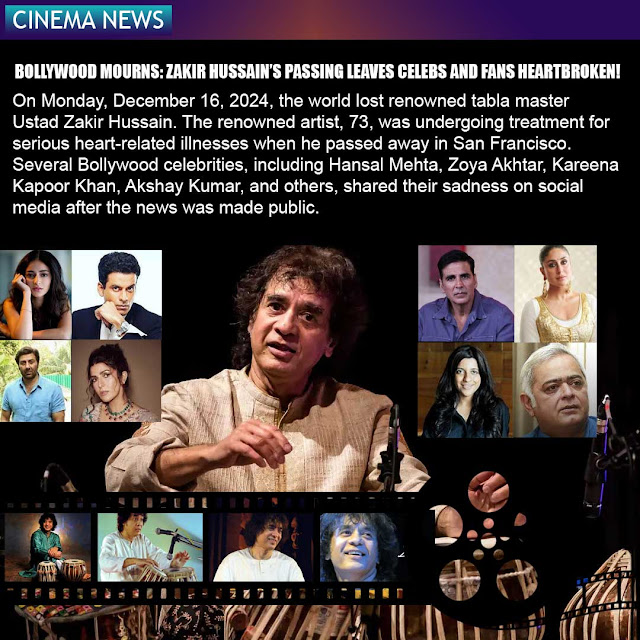
On Monday, the world lost renowned tabla master Ustad Zakir Hussain. The renowned artist, 73, was undergoing treatment for serious heart-related illnesses when he passed away in San Francisco. Several Bollywood celebrities, including Hansal Mehta, Zoya Akhtar, Kareena Kapoor Khan, Akshay Kumar, and others, shared their sadness on social media after the news was made public.
As soon as news of Zakir Hussain's death spread, Akshay Kumar shared a photo of the master on social media. He wrote, "very pained to know about the sad demise of Ustad Zakir Hussain Saab. He was truly a treasure for our country's musical heritage. Om Shanti."
Kareena Kapoor Khan also paid tribute to the well-known musician by sharing a heartfelt picture of herself with Zakir Hussain, Randhir Kapoor, and her father.
Director Hansal Mehta wrote his final farewell to the tabla master on X (formerly Twitter), “The maestro who made so many sleepless nights at Hindustani classical concerts memorable. The man who knew how to engage with an audience through his artistry. The Ustad who made the tabla sexy. Goodbye Ustad Zakir Hussain.”
Ananya Panday shared a picture of Zakir Hussain and a heart emoji on Instagram. Meanwhile, "REST IN PEACE, Ustad Zakir Hussain 1951-2024," was written by Rakul Preet Kaur. Ustad Zakir Hussain's Ji, may you rest in peace. You will always be missed and remembered.
Sunny Deol expressed sorrow at Zakir Hussain's departure and stated, "A monumental loss to India and the world of music with the passing away of Padma Vibhushan #Zakir Hussain, one of the greatest musicians ever. His contribution to music transcended borders. His legacy will forever resonate through the beats of his tabla. Rest in peace, maestro".
Manoj Bajpayee penned, "The rhythm of a maestro can never be muted. RIP Zakir Hussain Sahab AA. Shocked and heartbroken by his passing, his legacy will live on in every beat."
Additionally, filmmaker Zoya Akhtar shared a black-and-white image of Zakir Hussain with the statement on Instagram to show her sorrow, “Ustaad (red heart emoji) #therewillneverbeanotheryou #thankyouforthemusic #zakirhussain #maestro #nationaltreasure #RIP @zakirhq9.”
Actress Nimrat Kaur reflected on her last live performance of Ustad Zakir Hussain at the Prithvi Theatre earlier this year. She disclosed, “On Feb 28th, ’24, when I last watched Ustad Zakir Hussain live at Prithvi Theatre, I recall my heart beating to the beats of the sheer flawless genius of his talent. His international superstardom and the zenith of his achievements are forever here to inspire and energize us.”
She also revealed, “As a human being, to remain the most humble, gracious, and generous through his incomparable life journey is what remains etched as a life goal in my heart. Your kind eyes and mystical being shall outlive generations…rest in glory Ustad ji. Never shall there be another.”The 73-year-old artist has been suffering with blood pressure issues. As a result, his family sent him to a reputable hospital for treatment of serious illnesses. Despite the efforts of the medical staff and the prayers of his millions of fans, the musician tragically passed away. Gossips4fans - Bollywood, Hollywood and Tollywood Latest Information for you: Bollywood Mourns: Zakir Hussain’s Passing Leaves C..
Postage stamp issued in memory of legendary Bollywood actor, producer, director Raj Kapoor. PHOTO: By India Post, Government of India. @commons.wikimedia.org/
He would have been a hundred years old on December 14, and would have been perhaps receiving ovations – the actor, producer, director, showman, Raj Kapoor, of course!
Beginning his love affair with films in 1935, Kapoor spanned decades, making impressive films, winning much accolade and many important awards.
Producing and directing his own films became a regular thing for actor Kapoor soon and he came to be admired as the ultimate showman.
Kapoor developed a serious approach to filmmaking early. Not given to lavish sets and paraphernalia of the so-called showmen of the industry, Kapoor concentrated on the story, the emotions, the portrayal, the acting and the hidden messages. His singular touch could be seen on the minutest detail of a scene.
Poster of movie Phir Subah Hogi. PHOTO: wikimedia.org
A remarkable thing about Kapoor’s films was their positivity. Although presenting a grim picture of existing social conditions, they always had a light at the end of the tunnel.
‘Boot Polish’ was Kapoor’s production where he did not play any role and parts of which he perhaps ghost directed, was a striking film with two children left to survive on the streets, and being taught the value of honest work.
Kapoor’s own productions began presenting the promise of the future after that. Soon followed ‘Shree 420’ directed by him, portraying the allure of the city and its evils.
‘Mera Joota Hai Japani’ song from the film became a household song in Russia and Iran and many other countries. Audiences everywhere were taken up by the careless abandon of his character, and his strength of sticking it out in the face of adversity.
A few years earlier, in his film ‘Awaara’, Kapoor had introduced the famous Kapoor persona of a penniless bum with golden heart, wearing cropped pants. Eating ‘chana’ handed out by a vendor which he introduced in yet another of his films, ‘Anari’. ‘Anari’ perhaps gave Hindi Cinema its first mother-son love-hate kind of relation, with both Kapoor and Lalita Pawar excelling at it.
Kapoor’s films and his songs became cults. Kapoor was musically inclined and reportedly discussed personally the music and the lyrics of the songs in his films. He could play various instruments himself and made sure that the songs of his films were singable, meaningful and inspiring.
Poster for Teesri Kasam. PHOTO: indiancinema.sites.uiowa.edu/teesri-kasam
Kapoor’s ambitious project ‘Mera Naam Joker’ captured the idea of being a showman, with seeming dedication to Shakespeare’s ‘all the world is a stage’. Divided into three parts, and directed with his special touches, the first part of the protagonist’s adolescence is an excellent separate film in itself.
Kapoor’s films not only took a critical look at problems in the society, offering a commentary and a suggesting solution through the path of truth and honesty. His characters presented values dear to the middle class. Loyalty and friendship were as important in relationships, his films said.
His film ‘Bobby’ presented that love and friendship are above any social standing, and that change is necessary for a healthy future. The film carried away an entire generation under its spell. Young college students flooded movie theaters leading to ‘housefuls’. The rebellious teenagers became friends of young adults, and the music excelled in its appeal to the young.
The theme of social change became predominant in Kapoor’s later films like ‘Prem Rog’ and ‘Ram Teri Ganga Maili’. These two films focused on women’s social condition of widowhood and unmarried motherhood. ‘Prem Rog’ presented the onset of new ideas in the form of higher education. The film had some great acting flashes by his son, actor Rishi Kapoor, and his brother, Shammi Kapoor. ‘Ram Teri Ganga…’ also became a film promoting the woman.
Although considered master of the craft of filmmaking, Kapoor’s performances in films of other directors make it to top of the list of his work, putting him down for eternity as an actor.
Kapoor’s performance in ‘Jagte Raho’ became a benchmark for silent but telling performance. Directed by Sombhu Mitra and Amit Maitra, it was a commentary on the class systems, by writer and journalist K.A. Abbas. Kapoor gave one of his best performances in that film with another great performance by actor Motilal.
Still from Mera Naam Joker. PHOTO: videograb from YouTube
City featured in yet another excellent performance of Kapoor’s in ‘Phir Subah Hogi’. Based on Dostoevsky’s famous novel, Crime and Punishment, it was an intense and quite a dark film, with Kapoor portraying the sadness, anger and frustration of his character just right.
Dressing in dhoti again, Kapoor played Hiraman, the bullock cart driver in ‘Teesari Kasam’, directed by noted director Basu Bhattacharya.
Kapoor made Hiraman a simpleton, a straight forward and honest man who gave his heart to a courtesan going to a nautanki to perform. The human situation of pure love developing in the hearts of two dissimilar persons, and of love’s ultimate sacrifice, held a universal appeal. Kapoor’s third vow cut through the heart of not just his character, but also the audience’s.
Kapoor’s talent hit home in an unparalleled portrayal of an old man in ‘Dil Hi To Hai’. He handled the transition between old and young man with fluidity. Just like his brother Shammi Kapoor did it in ‘Professor’.
Still from Awaara Hoon song where Raj Kapoor looks at a watch he just pickpocketed. PHOTO: videograb from YouTube
Entertainment is the purpose of the art of the celluloid. What is noteworthy is that Kapoor tried to bring in message of change through entertainment.
Cinema is what he loved. He remained a true ‘show man’ till the end, smiling and joking about his own pain and discomfort in the face of cancer, so much so that director Hrishikesh Mukherjee based the main character of his film ‘Anand’ on him.
Kapoor seems to have believed that he was an actor on the stage of life, and he was going to play his part till the end. He did just that and also left behind a priceless legacy.
New Delhi, July 9: On the occasion of one of Bollywood’s most beloved actors, Sajeev Kumar’s birth anniversary, we celebrate the life and career of one of Indian cinema’s most versatile actors.
Known for his remarkable ability to portray a wide range of characters with depth and authenticity, Sajeev Kumar left an indelible mark on the film industry.
From intense dramas to light-hearted comedies, his performances have captivated audiences for decades.
Let us revisit these cinematic gems and celebrate the legacy of a true acting genius who continues to inspire and entertain cinephiles even today.
1. Sholay (1975) – Thakur Baldev Singh
Sanjeev Kumar’s portrayal of Thakur Baldev Singh in the epic blockbuster ‘Sholay’ is perhaps one of his most iconic roles. Despite being handless, his character displayed immense courage and determination in seeking justice, making him a pivotal part of the film’s narrative.
2. Angoor (1982) – Ashok R. Tilak/Bhura
In this comedy classic directed by Gulzar, Sanjeev Kumar showcased his exceptional comic timing by playing a double role. His portrayal of both Ashok R. Tilak and Bhura was lauded for its precision and humour, establishing him as a versatile actor.
3. Koshish (1972) – Hari Charan Mathur
‘Koshish’ remains one of the most poignant films in Sanjeev Kumar’s career. Portraying the role of a deaf and mute man alongside Jaya Bachchan, he delivered a deeply moving performance that showcased his sensitivity and depth as an actor.
4. Aandhi (1975) – JK
In ‘Aandhi,’ Sanjeev Kumar starred opposite Suchitra Sen in a role that highlighted his subtlety and ability to convey complex emotions. His portrayal of JK, a conflicted politician, added layers to the film’s narrative and earned him critical acclaim.
5. Khilona (1970) – Vijaykamal
‘Khilona’ marked a significant milestone in Sanjeev Kumar’s career, where he played the role of a mentally unstable man with utmost sensitivity and nuance. His performance not only garnered accolades but also touched the hearts of audiences.
Sanjeev Kumar’s contribution to Indian cinema continues to inspire generations of actors and filmmakers. His versatility, dedication, and ability to immerse himself in diverse roles remain unparalleled.Sanjeev Kumar’s legacy lives on through these timeless performances that have etched a permanent place in the hearts of movie enthusiasts worldwide. Remembering Sanjeev Kumar: Celebrating 5 timeless roles on his birth anniversary
New Delhi, (IANS) Megastar Amitabh Bachchan, who is the host of ‘Kaun Banega Crorepati 15’, has voiced his opinion for the field of acting, and shared how artists lead a good life, candidly giving his example.
Big B welcomed Ranjeet Kumar Singh, from Ramgarh, Bihar to the hot seat in the new episode of the knowledge based reality show.
During the gameplay, the ‘Sarkar’ actor asked the contestant: “What are you doing nowadays?”
To which he replied: “Sir, I'm in Mumbai currently. It's difficult to survive in Mumbai. I gave a walk-in interview in the optical industry and I got selected. Sir, I'm currently working there.”
“I'm struggling in this city to survive as I'm trying to be an actor. Sir, you know that villagers don't value acting as a profession,” shared Ranjeet.
The ‘Brahmastra’ actor asked him whether he is trying his luck nowadays or not, and the contestant said that he is giving auditions continuously.
“I have experience in the theatre.I was a part of the Villager Theatre Group,” said the contestant.
Amitabh said: “Please keep trying”, to which Ranjeet said: “Sir, I need your blessings.”
Big B said: “You already have my blessings.”
The contestant then went on to say, “Sir, I have a few words to say. I have a small request. Please tell my father once. When I act there are people in the village who ask if this is what I'm doing and I feel bad. Please tell my father that it's a nice field.”
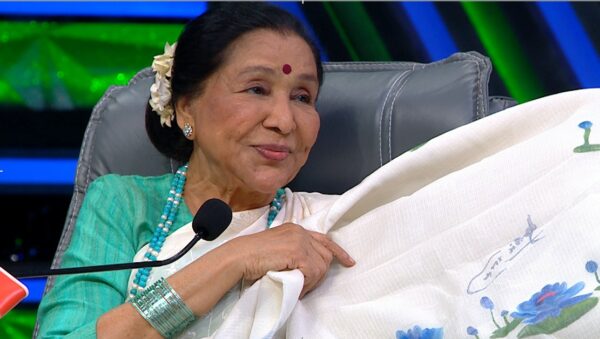
Asha Bhosle shows Lata Mangeshkar’s autograph. Photo: Genesis-BCW
Over the last three decades, Zee TV has been providing global platforms to Indians to showcase their singing, dancing, and acting talent. Their dance reality show, Dance India Dance (DID), revolutionized the landscape of dance in the country when it first began to air in 2009. Over the last 13 years, the platform has stood testimonial to the sheer passion and love that India holds towards dance. And Zee TV recently launched its top-rated reality show for the youngest dancing talent in the country—DID L’il Masters Season 5. This week, the L’il Masters celebrate the life of the legendary Lata Mangeshkar in the presence of her sister, Asha Bhosle. While the young talents impressed Asha as much as the judges during the shoot, it was Asha’s surprising revelation that left everyone speechless. When host Jay Bhanushali asked the late singer’s sister if she ever had a fan moment or if she took anyone’s autograph, she revealed that just before her sister passed away, she had taken the late singer’s signature on the pallu of her saree. Asha had even brought this saree of Lata on the set. As Asha said, “I have met some great personalities in my life, like Jawaharlal Nehru, Indira Gandhi and many more, but I have never asked for their autographs. I have only one person’s autograph, and that is Lata Mangeshkar. She called me inside her room when she was ill about six months back and said “Mujhse jo kuch chahiye, maang lo (Ask whatever you want from me).’ I was stunned, but after a while I asked her to give me her autograph on the pallu of one of her old sarees. I have even brought it with me today, as this is the most prized possession of my life and I don’t think that anything else can ever surpass it. I asked her to sign on the pallu so that it is visible to everyone whenever I choose to wear it.”Much has been made about the Lata-Asha professional rivalry for decades now, but the two sisters had reportedly been always close. When Asha Bhosle took Lata Mangeshkar’s autograph
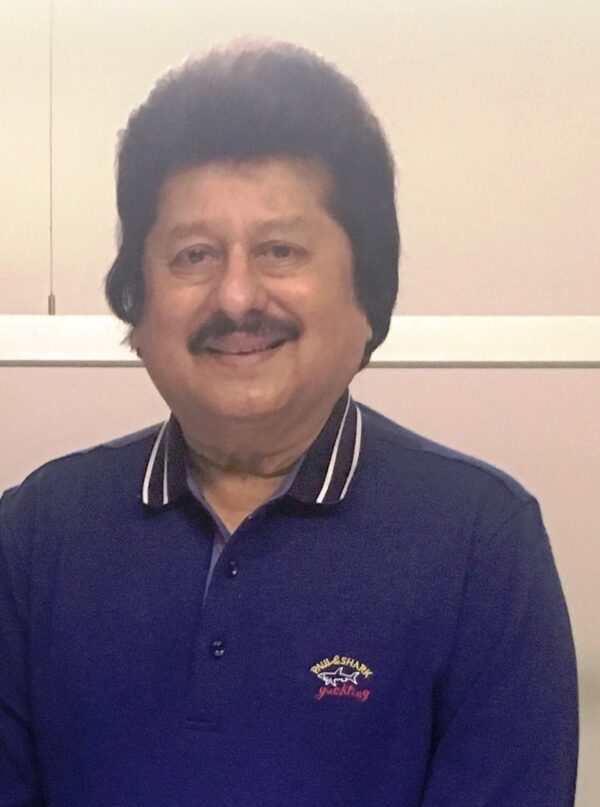
Pankaj Udhas almost single-handedly took the ghazal to the common man. Photo: Rajiv Vijayakar
Pankaj Udhas is no more. But he was no less, for he was the man who, almost single-handedly, put the ghazal and a lot of Urdu on every man’s lips, and was also someone who touched the hearts of NRIs (and also anyone who left home and hearth even within India) with the immortal Chitthi aayi hai from Naam, all of 44 years ago.
In those days when WhatsApp, Zoom or Face Time was not even thought of and only rare international or trunk calls saw those able to connect with family, the song, which lives on even now, provided succor to souls that had moved far from their loved ones to make it in life. The pen may have been Anand Bakshi’s, the composition Laxmikant-Pyarelal’s, and the concept Rajendra Kumar’s (who ghost-produced the film, along with director Mahesh Bhatt and writer Salim Khan, but what made it reach where it deserved and become immortal were Pankaj Udhas’ refined vocals.
Here are some lesser-known, rare or unknown facets of the owner of the velvet voice, whose own temperamental structure was as soft and friendly as his vocals.Pankaj hailed from Navagarh village near Jetpur in Gujarat, and was the youngest of three sons, Manhar and Nirmal being older, born to Keshubai and Jituben Udhas. His father worked in the government and it is said that they hailed from a family of farmers.
The famous veena player, Abdul Karim Khan, was known to Keshubhai and taught him to play the dilruba. This was the brothers’ first exposure to music.
“The radio was always on in our house!” Pankaj told me. “I loved film music, especially songs with a classical bent. I was a fan of Shankar-Jaikishan, Naushad, S.D. Burman and Roshan. Later, I was witness to how Laxmikant-Pyarelal replaced S-J and became their fan too.”
Of his idols, Pankaj recorded for Naushad in Guddu, but the song was never retained even in its album. He sang for L-P in, besides Naam, popular songs in Dayavan (Aaj phir tum pe pyar aaya hai), Jawaab (Sabak jinko wafaa ka yaad hoga and Mitwa re mitwa), Tejasvini (Woh ladki jab ghar se nikalti hai) and Mohabbat Ki Aag (Meri zindagi mohabbat).
Among other composers, he also sang for Khayyam (in the unreleased Mohabbaton Ka Safar) all the way to Jatin-Lalit (Vaade Iraade) and Himesh Reshammiya in Nigehbaan and for most top composers in between.
The actors for whom he lent his voice incredibly began with Shammi Kapoor (!) in Pyar Ka Rog. The list spanned Jeetendra (Thanedaar), Rishi Kapoor (Ghar Ki Izzat), Sunny Deol (Ghayal and more), Govinda (Mohabbat Ki Aag), Mithun Chakraborty (Gangaa Jamunaa Saraswati) Suniel Shetty (Mohra), Salman Khan (Yeh Hai Jalwa), Chunky Panday (Gunahon Ka Faisla), Raj Babbar (Jawaab) and more, all the way to Kay Kay Menon (Maan Gaye Mughal-E-Azam) and Manoj Bajpayee (Ghaath). Without lip-synch, there also were songs for Vinod Khanna (Dayavan) and Ajay Devgan (Ek Hi Raasta).
But in several cases after Naam, his songs were filmed on Pankaj himself as a ghazal singer, in films like Gola Barood, Saajan, Baazigar and Yeh Dillagi.
His co-singers included Lata Mangeshkar, Asha Bhosle and Kishore Kumar from among the stalwarts. Kumar Sanu, Mohammed Aziz, Vinod Rathod, Sukhwinder Singh, good friend Anup Jalota, Anuradha Paudwal, Kavita K. Subramaniam, Alka Yagnik, Sadhana Sargam and even Sharon Prabhakar and Penaz Masani and others sang with him.
Pankaj scored music as well, for Ek Hi Maqsad (1988), in which, besides Asha Bhosle and Anuradha Paudwal and himself, he also recorded with Aziz Nazan, the qawwal, in the fun song, Gadi na chal sake petrol ke baghair.
Pankaj learnt the basics of music from Ghulam Qadir Khan Sahab, and in Mumbai from Master Navrang Nagpurkar. Earlier, he had learnt the tabla.
But singing was far away from his ambition. He did his Bachelors in Science from St. Xavier’s College in Mumbai and had wanted to go into a related profession.
When elder brother, Manhar, got a singing break in Vishwas (1969), Pankaj was fascinated by the fact that composers Kalyanji-Anandji advised him to take Urdu diction classes from a moulvi (Muslim priest). Bewitched by that, he decided to make singing his profession, as he had his degree as a backup if that failed!
Pankaj had already developed a love for ghazals after listening to Begum Akhtar and Mehdi Hasan in particular. Composing came naturally to him and he also learnt the harmonium.
It was in Kaamna (1972) that Usha Khanna gave him the first break with the song Tum kabhi saamne aa jaao, a song that was clearly Mukesh-like tenor—all the Udhas brothers have a Mukesh-esque tenor.
For this very reason, 22 years on, Viju Shah chose Pankaj to render Na kajare ki dhaar for Mohra. The song had actually been recorded by its composers Kalyanji-Anandji, Viju’s father and uncle respectively, with Mukesh and Lata Mangeshkar for a film that never took off!
However, Pankaj decided to try his luck overseas as there was little scope then in India for ghazal He was appreciated, returned in 1979 and came out with his first album, Aahat, in 1980.
The 1980s saw a ghazal and bhajan boom as film music standards seemed to go down under the disco avalanche. Music lovers seemed to miss good lyrics and desi tunes and Pankaj was in the forefront of this alternative music wave alongside Jagjit Singh, Anup Jalota, Talat Aziz and others.
Anup, Talat and Pankaj soon formed a tight clique of friends who went on to do concerts together as well.
Shortly afterwards, filmmaker Ravi Tandon (Raveena Tandon’s father) requested Pankaj to sing for his new film, Jawaab. Pankaj had no time from his ghazal recordings and performances, and even littler inclination, but Tandon requested a re-think as the hero was a ghazal singer in the film. Pankaj agreed and recorded Sabak jinko wafaa ka yaad hoga and Mitwa re mitwa, both of which soon became a compulsion in Pankaj Udhas compilations on Universal Music until physical forms (cassettes and CDs) were marketed. Pankaj terms the first number “One of my better-rendered film songs.”
Shortly afterwards, an amusing incident occurred. Erstwhile top star and then producer Rajendra Kumar called up Pankaj and told him, “You have to act in my film!” Pankaj, then at the peak of his popularity, had no such leaning, and told him he would get back, but did not. Elder brother Manhar, who was close to the actor, asked him why he was being disrespectful to a senior composer, and when Pankaj told him the reason, suggested that he call and explain his stance. However, Rajendra Kumar laughed and apologized and said that all he wanted was the song performed by Pankaj himself on stage. And history was made, as this song was Chitthi aayi hai.
Pankaj had revealed to me that Laxmikant was not really happy with his nuances after three ‘takes’ at the recording and organized a ‘live’ kind of feel with the singer sitting, as he did in stage shows, at the studios. That did the magic.
Pankaj later sang extensively for Bappi Lahiri, Nadeem-Shravan, Anand-Milind and Anu Malik.
Not restricting himself to Hindi, Pankaj also sang in mother-tongue Gujarati, Marathi, Marwari, Punjabi, Bengali and even Kannada!
Countless non-film ghazals was what Pankaj was about. And yet, he did sing devotionals as well for films like Maa Santoshi Maa (2003) and Maalik Ek (2010).
The Padma Shri, with which he was honored in 2006, remains the biggest of almost 20 noteworthy awards and honors Pankaj has received in his illustrious lifespan.
Accused of commercializing the ghazal form (which actually is a genre in poetry, not music) by purists, he humbly took credit instead for simplifying it and taking it to the common man, maintaining this connection by making his tunes and vocals simple and modifying the orchestration and sound from the 1980s to the millennium. His credo was “You cannot really appreciate or come to love something that you cannot understand!”
The moulvi’s teachings had already shown that communication was also about expression. And that is why, unlike most non-film talents that ventured into cinema, Pankaj triumphed and sang close to a hundred film songs, ranging from his core expertise to romantic duets, fun songs and more.
Pankaj celebrated 25 years of his work with extensive concert tours including in the US and Canada under the tagline of Watan Se Chitthi Ayee Hai. This, he said, not only commemorated his bringing in the aroma of their motherland for Indians but also his most famous song, for no Pankaj Udhas concert, anywhere in the world, is complete without his singing Chitthi aayi hai.
And finally, as per my personal experience at one of his concerts, Pankaj himself would break down at some point while performing that timeless gem that he almost did not record!Pankaj Udhas: Lesser-known facts about a unique maestro