Mumbai, (IANS): The entire Spider-Man film franchise is scheduled for a re-release across India this November commencing with Tobey Maguire as the web-slinger.
From Sam Raimi’s iconic Spider-Man trilogy starring Tobey Maguire to Marc Webb’s The Amazing Spider-Man films featuring Andrew Garfield, and from blockbuster adventures of Tom Holland in the Marvel Cinematic Universe to the visually groundbreaking Spider-Verse saga, cinephiles will experience every era of the superhero on the big screen once again.
The saga will begin with Tobey Maguire as Spider-Man on November 14. On November 21, Andrew Garfield will be lighting up the screens. Tom Holland will be seen as the web-slinger on November 28th and on December 5 onwards the Spider-Verse: The animated multiverse will commence.
The re-release is designed as a celebration for both longtime fans and a new generation discovering the hero’s journey. Each film will showcase Peter Parker’s evolution from an ordinary teenager into the ultimate friendly neighbourhood Spider-Man.
Shony Panjikaran, General Manager and Head of Sony Pictures Releasing International, India, said in a statement: “Spider-Man is one of the most enduring and inspirational characters in the world.”
“Bringing back all his films to Indian cinemas is a way to honour the fans who have loved him for decades, while also giving new audiences the chance to experience these iconic stories on the grandest scale.”
Spider-Man is a superhero in American comic books published by Marvel Comics. Created by writer-editor Stan Lee and artist Steve Ditko. Considered one of the most popular and commercially successful superheroes, he has been featured in comic books, television shows, films, video games, novels, and plays.Spider-Man has the secret identity of Peter Benjamin Parker who was raised by his Aunt May and Uncle Ben in New York City after the death of his parents. Lee, Ditko, and later writers had the character deal with the struggles of adolescence and young adulthood. Spider-Man film series to hit Indian big screens again in November | MorungExpress | morungexpress.com
Venice: Danish director May el-Toukhy (R) of the film Woman Unknown, also the winner of the Golden Lion for Best Film, and Mathilde Arcel, winner of the Best Actress for Woman Unknown, pose together with their trophies at the 83rd Venice International Film Festival in Venice, Italy, Sept. 12, 2026. The 83rd Venice International Film Festival closed on Saturday on Venice's Lido. (Photo: Xinhua via IANS)
Los Angeles, (IANS) Hollywood actress-director Maggie Gyllenhaal, who earlier made a defining statement about the lack of women filmmakers, has now reacted to awarding the Golden Lion to ‘Woman Unknown’ directed by a female filmmaker May el-Toukhy at the Venice film festival.
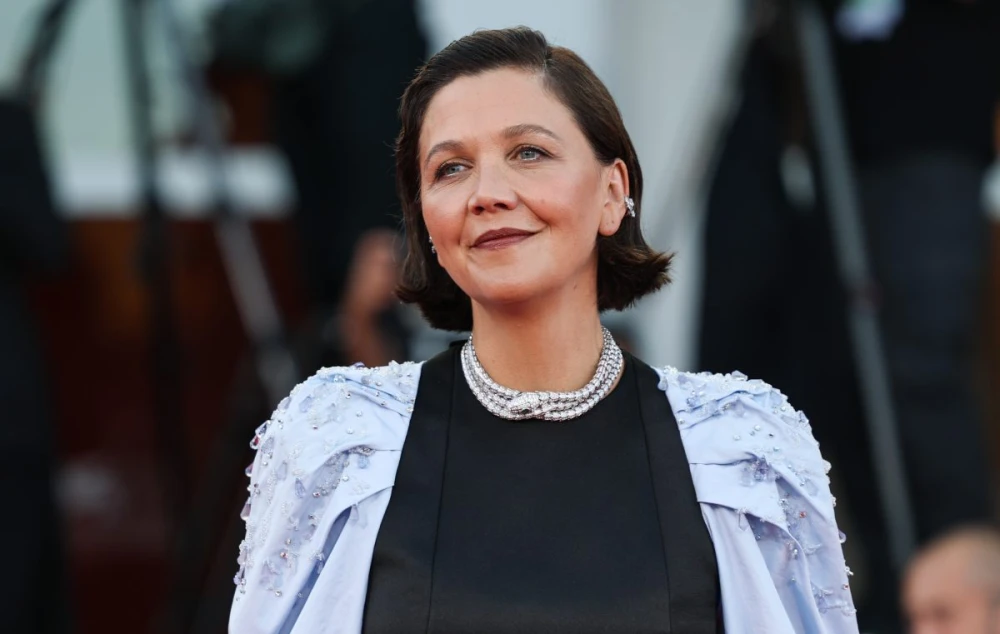
Venice: U.S. actress and director Maggie Gyllenhaal, president of the 83rd Venice Film Festival Jury, poses at the red carpet of the 83rd Venice International Film Festival closing ceremony in Venice, Italy, Sept. 12, 2026. (Photo: Xinhua via IANS)
The actress, who serves as Venice jury president, spoke at the press conference, and rejected the notion that she and her fellow jury members were making any sort of “political statement” by awarding the film.
She said sarcastically, “I actually didn’t see ‘Woman Unknown’. I just was like, ‘It’s made by a woman and so, Golden Lion’”
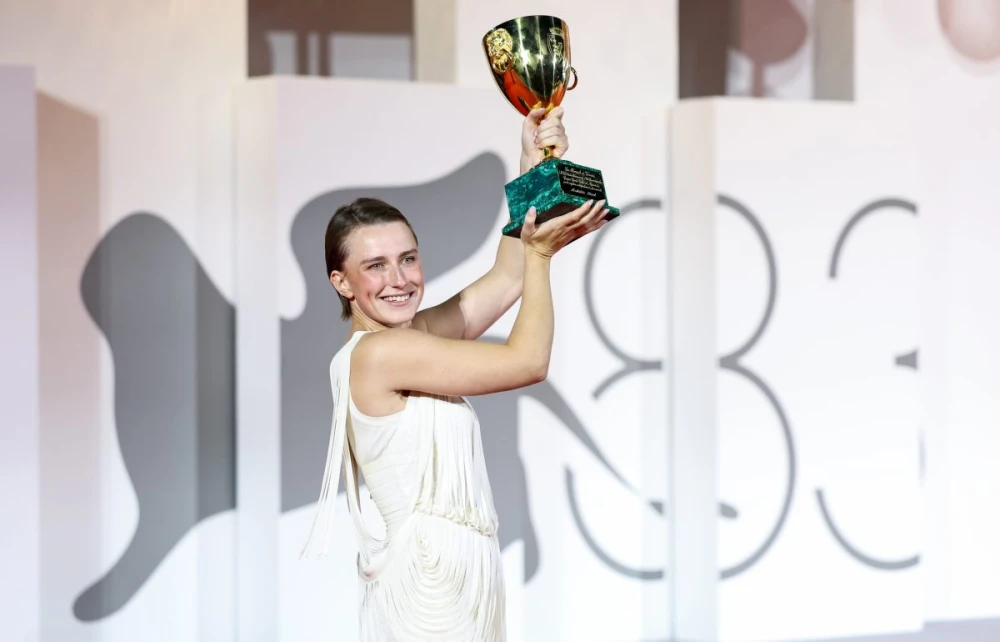
.Venice: Mathilde Arcel of the film Woman Unknown poses with the trophy for Best Actress at the 83rd Venice International Film Festival in Venice, Italy, Sept. 12, 2026. The 83rd Venice International Film Festival closed on Saturday on Venice's Lido. (Photo: Xinhua via IANS)
She went on, “I will say that, of course, I anticipated that question. There are many movies that women made that I don’t like and some that I actively, strongly don’t like, just like films made by men. I have one vote just as each member of this jury does, and so all of the decisions that we make are always complicated, always involve a lot of conversation”.
“I think I’m tired of talking about this same subject over and over. I will continue to do it, but just for a minute, here in this incredible place, I just want to celebrate a beautifully made movie that I felt was like a laser beam just for the well-made movie that it is”, she added.
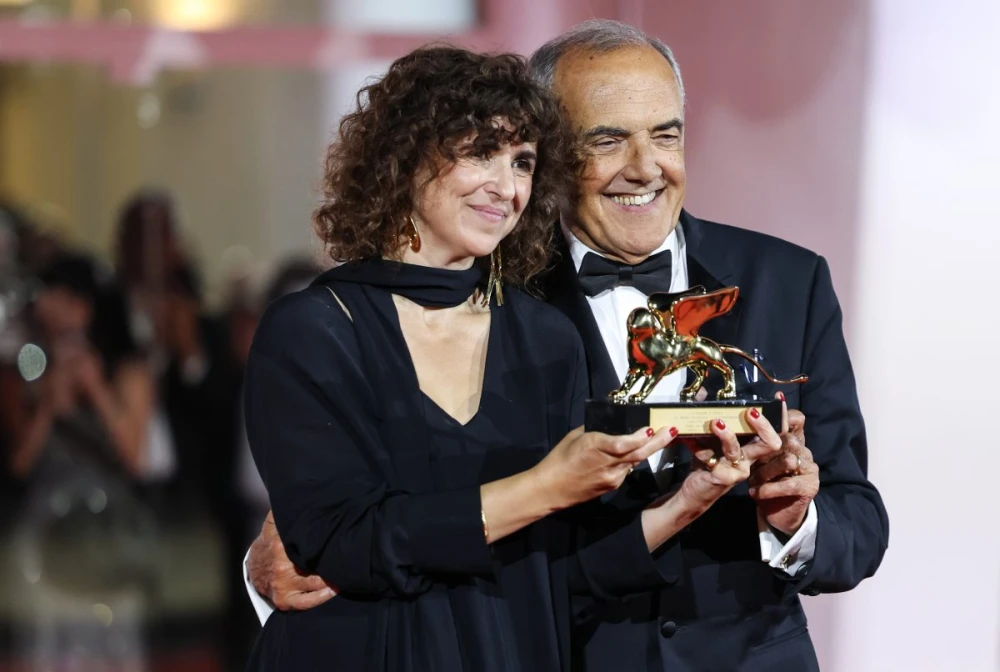
Venice: Danish director May el-Toukhy (L) of the film Woman Unknown, also the winner of the Golden Lion for Best Film, and Alberto Barbera, artistic director of the 83rd Venice International Film Festival, pose together for photos at the 83rd Venice International Film Festival in Venice, Italy, Sept. 12, 2026. The 83rd Venice International Film Festival closed on Saturday on Venice's Lido. (Photo: Xinhua via IANS)
Gyllenhaal’s jury also consisted of ‘The Voice of Hind Rajab’ director Kaouther Ben Hania, Hong Kong filmmaking giant Johnnie To, Afghan filmmaker Shahrbanoo Sadat, French director and screenwriter Xavier Giannoli, ‘The Brutalist’ composer Daniel Blumberg and U.S.-based Italian film academic Francesco Casetti.
The only other movie in competition involving a woman director was the Israeli narrative film on Palestine, ‘NAZA’ which was co-helmed by Rachel Szor and Yuval Abraham.
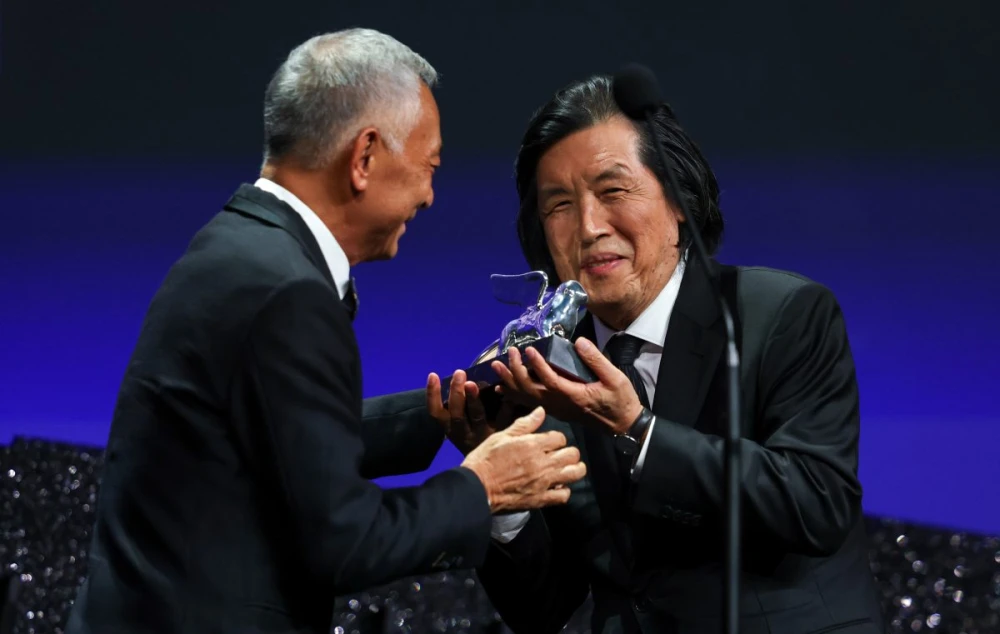
Venice: Director Johnnie To (L) from China's Hong Kong Special Administrative Region, also a member of the 83rd International Venice Film Festival Jury, gives the trophy of the Grand Jury Prize to South Korean director Lee Chang-dong of the film Possible Love at the 83rd Venice International Film Festival in Venice, Italy, Sept. 12, 2026. The 83rd Venice International Film Festival closed on Saturday on Venice's Lido. (Photo: Xinhua via IANS)
Los Angeles, (IANS) Hollywood actress Dakota Fanning has shared that the thought of working together on ‘The Nightingale’ with her sibling Elle sent them spiralling in panic.
‘The Nightingale’ is a historical drama. Dakota spoke about feeling anxious prior to shooting the movie adaptation of Kristin Hannah’s war novel.
Dakota recently appeared on ‘The Tonight Show Starring Jimmy Fallon’, where she said, "We were quietly nervous about it. I think we didn’t really want to tell the other one how nervous we were”.
Dakota, 32, shared that she was initially unsure how they'd work around on a movie set, as she said, "We were like, ‘Are we gonna laugh? Like, are we gonna be able to keep it together?’ It’s the person that knows you best in the world that you’re acting with, and we’re super close. We were a little silently panicked. I was nervous because she had made it clear that I was not allowed to do any older sister behaviour on set. I had to treat her like I would treat any other actor. And I did, for the most part”.
Their dynamics as siblings were exposed during a particular moment, as Dakota said, "Right towards the end, there was a scene we were doing, it was like this really hot room and we were on this couch, and I was like, ‘Move your leg’. And she was like, ‘My leg has been here all day’. I was like, ‘No, it hasn’t. Get off of me. I’m too hot. You’re sweating on me’. She was like, ‘You’re sweating on me’. I was like, ‘Stop talking’”.
Dakota recalled the movie's crew breaking into laughter over the incident.
Los Angeles, (IANS) Hollywood actress Kristen Stewart isn’t too much of a fan of what she did in ‘Twilight’. The actress has said that she felt she was a "pretentious little loser" while shooting for the film.
The 36-year-old actress, who was just 17 years old when she shot the first movie in the series, reflected on playing Bella Swan.
She also spoke about how seriously she and her co-star Robert Pattinson took the project. The actress said on the ‘In Your Dreams With Owen Thiele’ podcast, “The first one, we were talking about this earlier ‘cause someone else asked about it, but I was like such a pretentious little loser. It was so so serious. Me and Rob were like, ‘Yeah, this is like f****** epic, like, let’s try and, like, elevate this s***’. And it’s like, just be exactly what age you are, and like say the words”.
The actress further mentioned that she and Robert, 40, had a very "teenage" attitude at the time.
She said in jest, “It was always like, ‘Oh my God, embarrassing. God, I just wanted to be like f****** real and it’s, like, impossible. Everyone’s like making it f****** impossible for it to be like f****** real. And then you look at it, and you’re like, it was f****** real. “Anything too much is so perfect for that period of time, where you're not going to do subtle stuff when you’re, like, a teenager dying”.
The actress, who dated Robert for four years after meeting him on the set of the first film in 2008, said that it took some time after the films ended to appreciate them for what they were.
She said, “It's really funny ‘cause it was like we did five of those movies, and it took five years, and then we've never stopped talking about it. During the time in which they were coming out, we were always being asked to look at it from the outside, which was not possible to do yet”.Her comments about the serious nature of the performances echo similar marks made by Robert in April. Kristen Stewart reflects at her work in ‘Twilight’: 'Pretentious little loser' | MorungExpress | morungexpress.com
Mumbai, (IANS) Global star and humanitarian Angelina Jolie has marked the first anniversary of the Cambodia border conflict, saying the country, where her son Maddox was born, continues to hold a special place in her heart.
The Oscar-winning star penned a note on Instagram, where she spoke about how nearly 30,000 people remain internally displaced.
“One year ago, conflict broke out along Cambodia’s border, upending the safety and stability of so many. Now, nearly 30,000 people remain internally displaced and unable to return home,” she wrote.
Angelina shared that the place is her son Maddox’s birth country
“Cambodia has always been a special country for me and my family. This is my son’s country of birth, our home is here, and for over 20 years, we’ve worked with a fully locally-led team on conservation and community development. The Maddox Foundation is headquartered on the same border where the recent conflict took place,” she added.
“I have had the honor of becoming close friends with my neighbors and the Foundation team as we demined and developed the area together. When the fighting broke out last year, we had to evacuate our staff and their families — a painful reminder of just how quickly conflict can return.”
Jotting down points about why she loves Cambodia, Angelina wrote: “I love this country and its resilient, warm people. While we’re grateful to have resumed our work protecting the land and supporting the community’s health and livelihoods, my heart is with everyone still waiting to come home.”
Angelina is the recipient of numerous accolades, including an Academy Award, a Tony Award and three Golden Globe Awards. She is known for her humanitarian efforts.The causes she promotes include conservation, education, and women's rights. She has been noted for her advocacy on behalf of refugees as a Special Envoy for the United Nations High Commissioner for Refugees. She has undertaken field missions to refugee camps and war zones worldwide. Angelina Jolie reflects on Cambodia conflict, says son Maddox's birthplace remains close to her heart | MorungExpress | morungexpress.com
Mumbai, (IANS) Hollywood star Jessica Alba is celebrating a major milestone in her daughter Honor’s life as she graduated.
Alba shared a few glimpses on Instagram from Honor’s graduation weekend surrounded by family and close friends, the actress described the occasion as a “full-circle moment” and expressed pride in the young woman Honor has become.
“What a weekend celebrating our Honorcita. Surrounded by our fam and chosen family, who have loved and supported you over the years, felt like such a full-circle moment,” she wrote in the caption.
She added: “We are endlessly proud of the young woman you’ve become and constantly in awe of the way you move through the world - with kindness, confidence, curiosity, and heart.So to our graduate Honorcita - we love you so much. The best is yet to come my sweet angel…”
The actress, on May 30, said that her “heart aches with pride” as she talked about her daughter’s journey of watching her little girl grow into a young woman.
Sharing a string of images from the graduation ceremony on Instagram, Alba wrote: “My baby girl graduated yesterday and my heart aches with pride. To my Honorcita - It feels like yesterday I was holding you in my arms, and in the blink of an eye, you’re standing here ready for your next chapter.”
The 45-year-old actress said that when she closes her eyes, she can “still see the little girl who wanted one more bedtime song, one more story, and endless cuddles. And now, you’re graduating.”
“Honor, what I’ve always admired most about you is that you’ve never been afraid to be exactly who you are. You never followed the crowd, never settled for who others expected you to be, and never stopped chasing what felt true to you.”
“You move through the world with conviction, curiosity, kindness, and a courage that inspires everyone around you. Watching you grow into the young woman you are today has been one of the greatest privileges of my life. To say I’m proud of you is an understatement,” said Alba.Alba added: “Time is fleeting. Time is sacred. And every moment of being your mom has been one of the greatest gifts of my life. Congratulations, baby girl. I love you forever and always.” Jessica Alba on celebrating daughter Honor’s graduation: A full-circle moment | MorungExpress | morungexpress.com
Anantapur: Actress Aishwarya Rai addresses the birth centenary celebrations of Sri Sathya Sai Baba in Puttaparthi, Anantapur district, Andhra Pradesh, on Wednesday, November 19, 2025. (Photo: IANS)
Mumbai, (IANS) Bollywood actress Aishwarya Rai Bachchan, who has been away from the silver screen for quite some time, was seen jetting off to the ongoing edition of the Cannes Film Festival.
The actress was accompanied by her daughter Aaradhya Bachchan as the two twinned in black. The mother-daughter duo posed for the paparazzi before they walked to the departure section of the Terminal 2 of Chhatrapati Shivaji Maharaj International Airport.
Aishwarya Rai is a regular at Cannes, and is known for her iconic looks at the red carpet of the film festival. Over the years, the actress has built a solid rapport at the fest, and draws huge reaction from the international media.
Earlier, the actress celebrated 19 years of marital bliss with Abhishek by dropping perfect family pics on social media. The photographs posted by Aishwarya showed her posing for some happy clicks with hubby Abhishek and their daughter Aaradhya Bachchan.
While in the first snap, the three of them are posing next to a lovely bouquet, the second had them simply flaunting their beautiful smiles.The duo reportedly first met back in 1999 for the photo shoot of their first project together, ‘Dhaai Akshar Prem Ke’.
Their friendship slowly and steadily transformed into love. After being in a relationship for some time, Aishwarya and Abhishek finally tied the knot on April 20, 2007.
On 16 November 2011, the couple stepped into the next chapter of their lives as they welcomed their daughter Aaradhya Bachchan.
Prior to this, Aishwarya and Abhishek recently made headlines as they made a rare appearance together at Sachin Tendulkar's son Arjun Tendulkar's wedding on March 5.While Aishwarya looked as beautiful as ever in a blue and silver anarkali suit, Abhishek opted for a black sherwani. The couple was seen smiling and posing for the cameras before entering the venue. Abhishek and Aishwarya attended the event with Amitabh and Jaya Bachchan. Aishwarya Rai Bachchan heads to Cannes with daughter Aaradhya | MorungExpress | morungexpress.com
Los Angeles, (IANS) Hollywood actress Anne Hathaway has admitted to being under pressure while filming for ‘The Devil Wears Prada 2’. The actress shared that she felt the weight of "pressure".
The Oscar-winning actress reprised the role of Andrea 'Andy' Sachs for the long-awaited film sequel, and while Anne was conscious of the outside pressure, she didn't allow it to bother her on set, reports ‘Female First UK’.
The 43-year-old actress told E! News, "I’m kind of through that time in my life. I don't really want to focus on that part. I just kind of accept it. Of course, there's pressure, of course there's expectation, of course there's these things. But this is the team that did it the first time. I would have felt scared if I was with a different team”.
Anne observed that the new movie also shines a light on "just how deeply and passionately people love fashion".
She added, "So many people have told me that they dreamed big for their lives because of these characters. It’s been overwhelming to see that that is as true in New York City as it is in Seoul, South Korea, as it is in Shanghai. It's been overwhelming”.
As per ‘Female First UK’, Anne previously shared that she considers acting to be an "unusual" job. The actress loves being able to "go back and forth" between big-budget Hollywood movies and independent films.
She told WWD, "It’s such an unusual job that you sign up for, and I’ve never felt like I’ve, perhaps some people who only make billion-grossing movies can feel this way, but if you love independent cinema as much as I do, you’re always grateful for the jobs that keep the lights on and being able to go back and forth between the two of them”.Anne said that she "didn’t have any confidence" in her 20s. Anne Hathaway talks about feeling the heat during filming of ‘The Devil Wears Prada 2’ | MorungExpress | morungexpress.com
Los Angeles, (IANS) Hollywood actress Hailee Steinfeld has shared that she is extremely fond of "uninterrupted" family time.
The 29-year-old actress is married to NFL star Josh Allen and Hailee has opened up about their home life, following the recent birth of their first child, reports ‘Female First UK’.
She told Architectural Digest, "I value a meal away from technology, and even if it's just the two of us, (or) if it's us with friends, with family, that time is so limited with the opportunity to have uninterrupted conversation over a great meal”.
Hailee, whose mother is an interior designer, said she and Josh want their home to feel warm and welcoming. The actress, who gave birth to her daughter on April 2, said, "We wanted our home to feel bright and airy and comfortable, and lighting is a big thing for me, warm, soft lighting”.
As per ‘Female First UK’, the couple split their time between New York state, where Josh plays for the Buffalo Bills, and California, and Hailee wants both spaces to have the same inviting quality. The Hollywood star said, "Home is somewhere you could spend hours in and not get tired of”. Hailee married Josh in 2025, and the NFL star previously admitted that he feels "proud" of his wife. Josh, who is one of the best-paid sportsmen in the world, heaped praise on the actress following her starring role in Sinners and he described the horror film as "fantastic".
Speaking to reporters at the Buffalo Bills training, Josh said, "I'm so excited for her and so proud of her. "It's getting some great reviews and it's a fantastic movie, so go watch it”.Josh is one of the best-known players in the NFL, but he's happy to take a back seat to Hailee and her success. The sportsperson, who started dating Hailee in 2023, shared, "I'm just there trying to support her in whatever way that I can. That was her moment and I'm so glad she got to shine”. Hailee Steinfeld talks about her craving for 'uninterrupted' family time | MorungExpress | morungexpress.com
Los Angeles, (IANS) Hollywood star Lisa Kudrow, popular for playing the iconic character Phoebe Buffay, was wary of leaving “Mad About You” for the then-unknown sitcom “Friends”, so was keen to "preserve" her role if possible.
She played Phoebe Buffay for 10 years on the beloved comedy series, but when she was first cast in the role, she had a recurring role as a sarcastic and indifferent waitress in an already-established comedy series.
She told Vanity Fair magazine: “I was really proud to be able to have a role on Mad About You.
“Honestly, when I shot the pilot of Friends, I thought, 'Yeah, I mean, this is a good show. But good shows don't get picked up all the time.'
"Thank God for Mad About You, which was my favourite show on TV. I mean, I thought that was such a great show. It was a quality multi-camera show…”
“If there's any hope of me being able to stay on Mad About You, after the (Friends) pilot doesn't get picked up or they pick it up for, you know, 12 more episodes, and then that's it... like after this fails, because there's no telling what's gonna happen, something can be great, and still, it gets cancelled, I'd still have Mad About You.
"I was preserving Mad About You for myself.”
After Lisa was cast in Friends, which debuted in 1994 and also starred Jennifer Aniston, Courteney Cox, David Schwimmer, Matt LeBlanc and the late Matthew Perry, the channel had a dilemma as to how to explain away the fact the same actress would be appearing in two primetime shows as different characters, reports femalefirst.co.uk.
So the actress was delighted when her Mad About You character, Ursula Buffay, was introduced as Phoebe's twin sister, adding depth to her back story.
She said: “Friends found that they had to justify why this same face and voice is gonna be on at 8:00 p.m. on Mad About You once in a while, and then there she is at 8:30 p.m. on Friends.
They had to cope with that. And incorporate Ursula into Friends. I was thrilled, you know, that I could still be Ursula."
The actress recently said that she has been catching up on old episodes of Friends but it "too embarrassed" to watch it in front of her husband Michael Stern.
Los Angeles, (IANS) Hollywood actress Lily Collins recently celebrated another trip around the sun. The ‘Emily in Paris’ actress shared a glimpse into how she marked her 37th birthday the day before.
The actress posted a carousel of photos on Instagram, and revealed that she celebrated the day with her husband Charlie McDowell, their daughter Tove, 1, and dog Redford, reports ‘People’ magazine.
The day was also filled with cake, a scenic park walk and a trip to the beach. “Another year older and it just keeps getting better. SO grateful for this little life and big love. Thank you for the birthday wishes”, she captioned the pictures.
As per ‘People’, in the first photo, Collins could be seen sitting next to her director husband, 42, at a table with a white frosted birthday cake with lit candles in front of her. Charlie, who is also a screenwriter and producer, appeared to be singing to his wife, who flashed a huge smile.
This was followed by a snap of their dog walk with Redford in a picturesque park. The couple was joined by their daughter Tove, who was sitting in a baby carrier on Collins’ chest. The final two slides showed the young family’s visit to the beach, with Tove, who turned 1 last month, holding her dad’s hand as she walked in the sand. A sweet close-up of Tove then showed the tot playing in the sand while wearing a checkered white and orange dress and a white floral sun hat.“Mama Lily, also her lil bucket hatttt”, the actress’ ‘Emily in Paris’ co-star Ashley Park wrote in the comments section, while Charlie added three red love heart emojis. Reese Witherspoon, whose production company Hello Sunshine is co-developing a Polly Pocket movie starring Collins, also sent birthday wishes, writing, “Happy Birthday Cutie pie”. Lily Collins rings in 37th birthday with husband and daughter | MorungExpress | morungexpress.com
Los Angeles, March 13 (IANS) Hollywood actress Jennifer Aniston has shared that she always brings her A-game to the table when it comes to self-care.
The Morning Show actress is 57 now but has always taken the time to look after her skin and ensure she is eating well, and now her focus is on how she can be at her healthiest in her "later years", reports ‘Female First UK’.
She told E! News, “I’ve always been really good about self-care. I’ve always been really good about taking good care of my skin. That was one of my many gifts my moms gave me,. Taking care of my skin, washing my face, putting my creams on. It's sort of consistent. I just take good care of my skin and my diet, all of it”.
“I look at aging now as, 'How can I maintain my health inside, outside, mental health to the best of my ability', so that I can grow into my later years as gracefully as possible”, she added.
As per ‘Female First UK’, Jennifer starts her day with a workout followed by a meditation session and she thinks the latter has been particularly important for her wellbeing.
She said, “Boy, when you do meditate consistently, there's such a difference. And it's not like something you can put your finger on and go, ‘It’s because of this’. I don't know what it is that takes place, but something does”.“It feels like it's not so much a workout for physical sculpting, even though that is the end result. It just feels like for daily life. Functioning through the world. Especially as we get older and things we forget about, all the little areas, the little muscles that keep hiding over the years that think they'll never be found”, she added. Jennifer Aniston ensures she always has time for self-care | MorungExpress | morungexpress.com
Film critics – myself included – love to bemoan the death of high-quality cinema in the age of streaming, pointing to mediocre Best Picture Oscar nominees as evidence that the production of great (or even good) films is on the wane.
But perhaps things are changing. Are people sick of being inundated with short videos on TikTok and Youtube, and once again hankering for a cinematic experience? The quality of this year’s nominees suggests they are.
For the first time in a while, most of the nominated films are excellent – and nearly all of them are watchable.
My top pick: Sentimental Value
Joachim Trier’s Sentimental Value is my pick for the Best Picture Oscar. It’s the kind of meticulously crafted film in which the naturalism seems effortless.
The narrative follows acclaimed filmmaker Gustav Borg (Stellan Skarsgård), a quintessential Euro-auteur, who comes back into the lives of his estranged daughters Nora (Renate Reinsve) and Agnes (Inga Ibsdotter Lilleaas) following their mother’s death.
Gustav is making a new film, and wants his daughter Nora – an acclaimed theatre actress who has her own demons to battle (stage fright among them) – to star in it.
Nora assumes it’s a cynical manoeuvre for funding on her father’s part and refuses. So Gustav casts American star Rachel Kemp (Elle Fanning) instead, who is immediately out of her depth.
The drama unfolds around the family home in Oslo, interweaving narratives of the home’s history across generations with the tensions plaguing its current inhabitants.
Sentimental Value has a strikingly lyrical quality. Some may say it’s overdone, but every element is so perfectly executed that it doesn’t come across as pretentious or laboured. It is, in many respects, thoroughly sentimental – yet never feels like it’s performing this as some kind of effect.
Despite its considerable formal and narrative complexity, it plays in a starkly simple fashion, thanks to the light touch of Trier, coupled with stunning cinematography by Kasper Tuxen Andersen.
The lead performances by Reinsve, Lilleaas and Skarsgård are extraordinarily convincing and, perhaps more surprisingly, Fanning is awesome as the uncomfortable American trying to please the European artiste.
Sentimental Value brilliantly weaves a sense of European social and cultural history with carefully observed character moments, becoming, by the end, a kind of treatise on the affirmative potential of art to transcend and transform interpersonal barriers.
Despite the difficulties of life, the detritus of broken promises and hearts, and the disappointments minor and not so minor, we can still come together – beautifully and wholeheartedly – through the practice of that abstract dream that is called art.
Other excellent contenders
There are a few other strong contenders – films which, any other year, would have stood out above the pack.
Bugonia
Yorgos Lanthimos is one of the most acclaimed filmmakers of the past decade, and yet his films have been hit and miss. After his last great film, the 2015 black comedy The Lobster, Bugonia marks a return to form.
The film follows bumbling paranoiac conspiracy nut Teddy (Jesse Plemons) as he and his half-witted cousin Don (Aidan Delbis) kidnap Michelle Fuller (Emma Stone), the CEO of pharmaceutical company Auxolith.
Fuller is the kind of ruthless business leader who appears on the cover of Forbes magazine with the caption “Breaking Barriers” and who spouts endless nonsense about diversity while her company wreaks havoc on the planet and the people around them.
According to Teddy, she is also an “Andromedon” alien sent to Earth to enslave and exploit the human population, bringing death to humans as it has been brought to the bees.
The brilliance of the film largely revolves around its manipulation of our identification with the two leads. At times Teddy seems like a lunatic serial killer, and Fuller a heroic victim. At times we empathise with Teddy, while Fuller looks like a manipulative, cold-hearted sociopath.
The whole thing builds up to an immensely satisfying resolution, suitably nihilistic and absurd in equal measure.
As is often the case with Lanthimos’ films, the figures are caricaturish, but the comedic timing – and the oscillation between humour and discomfort for the viewer – is spot on, so it works.
Sinners
Ryan Coogler’s Sinners is a great yarn: a well-executed rock ‘n’ roll fable slash vampire siege, full of electrifying music.
It’s 1932. Twin gangster brothers Smoke and Stack (a dual role played by Michael B. Jordan) return from working for Al Capone in Chicago to Clarksdale, Mississippi, to open up a juke joint.
Their cousin Sammie (Miles Caton), a cotton picker and bluesman – with Charley Patton’s guitar – steals the show at the hugely successful opening night, fulfilling the legend of a musician who can play so well the barriers between the living and the dead come down. Everything seems to be going well – until some redneck vampires decide to assail the venue.
The whole thing is rather gaudy and silly. But like its forebear From Dusk Till Dawn (1996) – it’s so energetically (and pleasurably) handled that it doesn’t matter.
Michael B. Jordan is brilliant in the two roles, and the end result is a muscular, satisfying film that feels like a good pulp novel or comic book – capped off with a Buddy Guy jam session in the final moments.
Sinners is a delicious dream. It’s unlikely to win Best Picture; there was a time, not so long ago, when this kind of genre film wouldn’t have made it into the mix. But it’s well worth its more than two-hour runtime.
Marty Supreme
It would be hard to think of a stupider premise for a movie. In the 1950s, fast-talking entrepreneurial New York hustler Marty Mauser (Timothée Chalamet) has to raise money so he can make it to Japan to beat world number one Koto Endo (Koto Kawaguchi) in the table tennis showdown of the century.
Yet, director/co-writer Josh Safdie treats the premise with enough seriousness that we end up with a high octane sports film to rival Rocky IV. This is helped by the stunning cinematography by Darius Khondji. Shot on 35mm film, the images have a rich colour and texture rarely matched in digital cinematography.
There’s also a dynamite score from Daniel Lopatin, and an anachronistic soundtrack featuring several stellar 1980s pop tunes from the likes of Public Image Limited, New Order and Tears for Fears, to name a few.
Despite Marty’s arrogance, sweet-talking, womanising, con-artistry and generally bad behaviour, Chalamet invests the character with enough pathos and humour that he comes across as a thoroughly loveable – or at least likeable – rogue.
He is a crackpot whose self-belief and willingness to do anything to achieve his dream tricks the viewer into becoming equally invested in his absurd quest as he (and the film) bounce around New York and the world like a bright ping pong ball.
Marty Supreme is an odd – and oddly arresting – film capturing something of the madness at the heart of the American dream. Mauser does whatever he can to make it to Japan. And after several escapades – and some downright brutal scenes featuring cult director Abel Ferrara as an ageing gangster – he does make it.
The rest
Unusually for the Oscars, the pack of 2026 nominees is rounded out by several other good films.
Although not as good as some of his other films, such as Neighbouring Sounds (2012) and Bacurau (2019), Brazilian director Kleber Mendonça Filho’s The Secret Agent is a rollicking political thriller. Set in the 1970s, it features a standout performance by Wagner Moura as a dissident academic evading persecution from a brutal dictatorship.
Paul Thomas Anderson’s One Battle After Another is a wacky comedy occasionally masquerading as a serious political action thriller. It follows the burnt out leftist Pat Calhoun (Leonardo DiCaprio) as, with his daughter Willa (Chase Infiniti), he evades capture by police and a militia led by the moronic Steven J. Lockjaw (Sean Penn). The whole thing is pretty silly, but like its inspiration – Thomas Pynchon’s 1990 novel Vineland – it is fun nonetheless.
F1 is likewise good. This finely wrought racing flick follows all of the delightfully dumb cliches of the genre. Hard-boiled and burnt-out old timer Sonny Hayes (Brad Pitt) makes it to Formula One for the first time, and contends with a new era of racing epitomised by his nemesis, the brash young gun Joshua Pearce (Damson Idris).
It’s hard to imagine such a film being nominated for Best Picture in any other era; Tony Scott’s Days of Thunder (1990) is equally stupid, but better made, and has been universally lampooned by critics. But people seem to be craving (and appreciating) big screen popcorn films in an era where streaming and second-screen viewing has all but destroyed commercial narrative cinema.
Only three nominees stick out as dreary
Clint Bentley’s Train Dreams is an earnest but visually unappealing Netflix film, following a ho-hum period love story about class, racism and the American Dream. Joel Edgerton is solid as usual, and the film is watchable enough, but the whole thing seems rather tired. And the digital video look really doesn’t work with the kinds of exterior, panoramic images that dominate the film.
In Frankenstein, director Guillermo del Toro takes one of the duller, more proselytising novels in the Gothic canon and gives it a suitably ponderous treatment. Oscar Isaac hams it up in full actor mode as Dr Frankenstein. Jacob Elordi is ridiculous as the monster. And Christoph Waltz as Harlander delivers such humdingers as “Can you contain your fire, Prometheus, or are you going to burn your hands before delivering it?” (in case you didn’t know, the novel’s subtitle is The Modern Prometheus).
Made for Netflix, Frankenstein tries hard to look sumptuous with period décor, but it can’t mask the sterility of its digital images. While the novel, at least, has a simple elegance to it, del Toro’s version is meandering, gaudy and cheap-looking.
It is difficult to treat Hamnet – the unbearably pretentious latest film from director Chloe Zhao – seriously, because the filmmakers do it for you. Though there are some things to like – Paul Mescal, for instance, is nice to watch, the cast are generally proficient, and the score is fine – this self-satisfied nonsense plays more like an Instagram video performing its own seriousness than a genuinely engaging feature film.
7 hits out of 10
As usual, the best films of 2025 haven’t been nominated for Best Picture (where’s Sirât, Redux Redux, or Harvest?). Nonetheless, most of this year’s nominees are films that warrant watching more than once for a variety of reasons: pleasure, complexity, nuance.
Perhaps Hollywood is starting to make good films again after decades of superhero trash. Or, at least, the Academy has started to recognise them.
Los Angeles, (IANS) Hollywood actress Elle Fanning was taken by surprise when she was nominated for the Oscars for ‘Sentimental Value’.
The 27-year-old star is up for Best Supporting Actress at next month's Academy Awards ceremony but has confessed that she went on a night out with her sister Dakota Fanning before the nominations were announced in January, reports ‘Female First UK’.
Elle told The Hollywood Reporter, "I was not watching it. Dakota and I had gone out the night before. We had quite a late night. I couldn't compute. I go out bleary-eyed, and I'm like, 'Mom! Dakota! Wake up. I think I got it. I think I got it. I looked like a crazed zombie who was walking in circles saying, 'Is this real?'".
‘Sentimental Value’ received nine Oscar nominations and Fanning says that the most exciting nod for the Norwegian picture was Olivier Bugge Coutte's recognition in the Best Film Editing category.
The Maleficent actress said, "What Olivier has done with the film, and the way that it is edited and constructed, I'm so happy that he wasn't overlooked because it's so particular and he has such a keen eye and was so essential to the film. Editors, I've come to learn now in the producing process, too, hold the key to your performance in a lot of ways”.
As per ‘Female First UK’, Elle said that close bonds have been forged between Sentimental Value's cast and crew since the movie premiered at the Cannes Film Festival last year.
She said, "The fact that the family was held together and that no one was left out and that we get to continue the celebration with each other is really meaningful. I've been quite emotional about this whole experience. I'm still a little glassy-eyed and in shock over it all”.
The nod is the first Oscar nomination of Elle's career and she admits that the recognition feels particularly special because she has been acting since the age of two.
The actress said, "I've been acting since I was two. I've never gotten to have this experience before. (It's) my first time being nominated (for an Oscar). It does really mean something to me, to be recognised by my peers. I don't think you realise how special that feels until it happens”.
The Oscar nomination comes after a varied year for Elle, which also saw her star in the sci-fi action flick ‘Predator: Badlands’, and she explained how she never wants to be typecast.
She said, "You don't know what projects are going to come to you or what's being written at the time, but I have been very fortunate to be able to have these varied projects”.
Gene Hackman, an acting titan of 1970s and ‘80s Hollywood with more than 80 screen credits to his name, has died at 95. He was found dead in his home with his wife, pianist Betsy Arakawa, and his dog.
Hackman had a rugged, dominating and commanding presence on screen, known for his emotionally honest, raw and fierce performances. Always the tough guy, never the romantic lead, off camera he was shy and enjoyed the quiet life.
I first saw Hackman as a child in The Poseidon Adventure (1972). My dad put the film on for the upside-down ocean liner disaster sequences, but it was Hackman who left a lasting impression. I vividly remember being so moved by his final speech berating God for deserting the ship’s passengers and crew while he hangs from a pressure valve door over flames.
There is no actor who comes close to conveying authority with such humanity and reserve.
He was often referred to as the actor’s actor and mentioned by Hollywood A-listers such as Kevin Costner as the best actor they’ve ever worked with. Clint Eastwood, once Hackman retired, described him as “too good not to be performing”.
Hackman will leave a legacy to be studied and appreciated for years to come.
Finding a foot in show business
Born in San Bernardino, California, on January 30 1930, Hackman’s family moved to Danville, Illinois, when he was three. Hackman’s father left when he was 13, which he described to James Lipton on Inside the Actors Studio as his father “driving by with a casual wave goodbye”.
Hackman joked to Lipton the departure of his father at an early age made him a better actor.
Hackman left Danville at the age of 16 to join the marines, where he spent roughly four years. He was a rebellious child, but as Peter Shelley detailed in his biography of Hackman, the marine corps was the first time he gave in to authority.
After the marine corps, Hackman moved to New York wanting to become an actor, telling people he was inspired by tough guy James “Jimmy” Cagney.
In New York, Hackman struggled making a living as an artist while waiting for his breakthrough (his uncle told him to give up and get an honest job). Moving to California, he became friends early on with Dustin Hoffman (they finally appeared opposite each other in Hackman’s penultimate film, 2003’s Runaway Jury).
After struggling for years, Hackman landed his first credited screen role in 1964’s Lilith at the age of 34. He played a small part opposite upcoming star Warren Beatty.
As Hackman recounted to Lipton, Beatty told director Arthur Penn how great Hackman was in a scene they did together. That landed Hackman his breakthrough role playing Buck Barrow opposite Beatty and Faye Dunaway in the 1967 hit Bonnie and Clyde, earning him an Oscar nomination for best supporting actor.
Breaking through in the 1970s
It wasn’t until the 1970s that Hackman began his leading role career, starring in The French Connection (1971) as the unforgettable hard-boiled New York detective Jimmy “Popeye” Doyle. This role earned him his first Academy Award, for best actor.
He was to wait more than 20 years for his second and final Academy Award, for playing the ruthless Little Bill Daggett opposite Clint Eastwood in Unforgiven (1992).
Throughout the 1970s, Hackman was gaining huge popularity on screen, sharing records with the likes of Robert Redford and Harrison Ford as the highest grossing stars at the box office.
There are too many great Hackman performances to mention, but my favourites are Unforgiven, The French Connection, The Poseidon Adventure, The Conversation (1974), Hoosiers (1986), Mississippi Burning (1988) and The Royal Tenenbaums (2001).
The French Connection’s director, William Friedkin, said in an interview Hackman was anti-authority and anti-racism because of his upbringing in an area known for its large Ku Klux Klan presence, and his absent father.
Hackman almost pulled out of The French Connection one week into shooting because he didn’t like “beating on people” for a four-month shoot. He told Friedkin “I don’t think I can do this,” but Friedkin refused to let him go.
Hackman recalled he was eternally grateful Friedkin didn’t, as it was “the start of [his] career”.
Hackman said his character Popeye Doyle was a “bigot, an antisemitic, and whatever else you wanted to call him”, and he famously struggled to say the N-word in one key scene. He initially protested the line but eventually went with it, believing “that’s who the guy is […] you couldn’t really whitewash him”.
Hackman often played the character who had the greatest authority on the surface but slipped up, whether he was playing the hero or the villain. Even for a role such as Reverend Scott in The Poseidon Adventure, in which Hackman played a self-righteous preacher onboard the capsized SS Poseidon, he questions his religion as he leads the entire band of escapees to safety.
A life after acting
Hackman retired from acting in 2004 at age 74.
There are many stories about why he retired, like, as Shelley writes, not wanting to play Hollywood “grandfathers” and his “heart wasn’t in shape”, but his life after acting gives a strong hint: he had other interests.
Over the past 20 years, Hackman wrote three historical fiction novels, was a keen painter, and enjoyed exercise such as cycling. Married to classical pianist Arakawa from 1991 until their death, they lived in Santa Fe, New Mexico, where he designed his own home (yes, he also loved architecture!).
A man of many talents who played a kaleidoscopic range of authoritative roles, Hackman will almost certainly be remembered mainly for his tough-guy performance in The French Connection – though many will also remember him as the Hollywood actor’s actor.
Los Angeles, (IANS) Hollywood actress Rachel McAdams did not anticipate the hate for her role of Regina George in ‘Mean Girls’.
The actress has shared that she "didn't know how hated she would be" for playing school bully in the show, reports ‘Female First UK’.
The 47-year-old actress starred alongside Lindsay Lohan, Lacey Chabert, Amanda Seyfried, Lizzy Caplan, Daniel Franzese, Tina Fey and Tim Meadows in director Mark Waters' 2004 teen comedy.
As per ‘Female First UK’, in the film, Lindsay Lohan plays Cady Heron, a 16-year-old girl who transfers to a public high school after being homeschooled her whole life in Africa who carries out a plan to destroy the clique of popular girls The Plastics; Regina (played by Rachel McAdams), Gretchen Wieners and Karen Smith.
Rachel said that she wasn't prepared for Mean Girls to become a pop culture phenomenon nor the level of hatred film fans felt towards Queen Bee Regina.
Appearing on ‘The Graham Norton Show’, she said, "I didn’t know how hated she would be and for how long. The first time I saw the film with an audience I was with my best friend. Everyone cheered when Regina was hit by a bus, but my friend stood up and screamed, ‘Nooooo’”.
Her latest movie is ‘Send Help’, directed by horror master Sam Raimi, the film follows the struggle for survival for financial strategist and survival enthusiast Linda Liddle, played by Rachel, who ends up stranded on a deserted island with her boss Bradley Preston (played by Dylan O'Brien) after a plane crash.Discussing working with Raimi, who she previously teamed up with on 2022 Marvel Cinematic Universe film ‘Doctor Strange’ in the ‘Multiverse of Madness’, Rachel said, "He is so wonderful and such a kind and lovely man who makes dark demented films so I knew it would be a big reach”. Rachel McAdams didn’t expect hate for her ‘Mean Girls’ role | MorungExpress | morungexpress.com
Los Angeles, (IANS) Hollywood actress Margot Robbie is opening up on the special gesture for actor Jacob Elordi. The actress has shared that she gave "flowers on Valentine's Day" to Jacob.
The 35-year-old actress and her Wuthering Heights co-star formed a close bond on the set of the new big screen adaptation of Emily Brontë's classic, and they recently revealed how he filled her room with roses on February 14 last year, reports ‘Female First UK’.
She told Extra, "Jacob's getting a lot of credit. I actually got him presents, too. I would like that to be known. Yes, I gave him many things throughout shooting. I gave him flowers on Valentine's Day”.
Margot, who has been married to producer Tom Ackerley sine 2016, added, "I gave him a book of poetry. I have him a lamp once”.
As per ‘Female First UK’, she also had matching custom signet rings made for them both to commemorate the end of filming.
Each of the rings feature two skeletons in an intimate embrace, with a Bronte quote, "Whatever our souls are made of, his and mine are the same”.
The hand-enamelled gold rings were created by UK designer Cece Fein-Hughes, who has opened up about the project on Instagram.
She wrote, "What an honour it was to create matching pieces for Margot Robbie Jacob Elordi, celebrating their time filming together as Catherine and Heathcliff in the new Wuthering Heights”.
She wanted each detail to reflect "a story of passion, devotion and wild romance". The rings are engraved with the initials of the characters, as well as '1847-2026', which reference the year Bronte's classic novel was first published, and the release of the new film.
Cece shared, "Gifted to Jacob by Margot, the piece features two entwined skeletons in the exact pose of the iconic film poster, a quiet reminder that love never truly dies. As time passes and everything else withers away, what remains is the enduring bond between two souls”.Margot revealed Jacob's sweet Valentine's Day gesture and admitted it "made her day". Margot Robbie reveals her sweet Valentine's Day gift for Jacob Elordi | MorungExpress | morungexpress.com
Los Angeles, (IANS): Hollywood star Timothee Chalamet has scored his third best actor nomination at the Oscars. His latest nom is for his turn as table tennis protege Marty Mauser in Josh Safdie’s sports dramedy ‘Marty Supreme’.
The actor has become the youngest male actor to earn three acting nominations at 30, reports ‘Variety’.
His previous bids were for ‘Call Me by Your Name’ (which made him the third-youngest nominee ever in the category at 22 years old) and ‘A Complete Unknown’.
As per ‘Variety’, in this year’s best actor race, Timothee Chalamet is nominated alongside Leonardo DiCaprio, Ethan Hawke, Michael B. Jordan and Wagner Moura. ‘Marty Supreme’ also picked up nominations for best picture and best original screenplay, among other categories.
In addition to his best actor nomination, Timothee Chalamet is also nominated for best picture as a producer alongside Eli Bush, Ronald Bronstein, Josh Safdie and Anthony Katagas. At 30 years and 26 days old, he became the youngest person ever to be double-nominated for producing and acting in the same year, surpassing Warren Beatty, who held the record for 58 years. Beatty was 30 years, 10 months and 20 days old when he received his nominations for “Bonnie and Clyde” (1967).
Notably, he was also nominated for directing and screenplay. Timothee Chalamet won the Golden Globe for best actor (comedy or musical) on January 11 for his performance in ‘Marty Supreme’, making history as the youngest winner ever in that category. Last year, he won the best actor prize at The Actor Awards (formerly the SAG Awards) for his turn as Bob Dylan in James Mangold’s ‘A Complete Unknown’. At 29, he is the youngest ever to be awarded that SAG prize.If Timothee Chalamet were to win the Oscar, he would be the second youngest winner in best actor history behind Adrien Brody, who was 29 when he won for ‘The Pianist’. He would be the sixth youngest male acting winner in any category behind Brody, Timothy Hutton, George Chakiris and Heath Ledger. Timothee Chalamet makes Oscars history as youngest man with 3 acting nominations | MorungExpress | morungexpress.com
Los Angeles, (IANS): Hollywood actress Kaley Cuoco has shared that she was "really scared" to leave her daughter for work.
‘The Big Bang Theory’ star, who has two-year-old daughter Matilda with her fiance Tom Pelphrey, was away from home for two months last year as she filmed new mystery thriller series ‘Vanished’, and she has praised her partner for making it easier, reports ‘Female First UK’.
She told Extra, "I have to say I was really scared. Like, I had a 2-year-old and I was like, ‘Should I be, like, leaving for two months?’. I just didn’t know if that was the right decision. My fiance was just like, ‘You've got to go. I think this is going to be amazing for you’. So, he really encouraged me to go, and he took care of everything and we kind of swapped places for a minute and I couldn't have done it without him”.
As per ‘Female First UK’, Kaley added that she has "much gratitude" for the way he "relieved her of the worry", while she also wanted to encourage her daughter to "follow your dreams".
She said, "I also want to show my child, like, that I love to work and you got to, you know, go do your thing and follow your dreams and still come home and have your home base. "But I think it's important to show her that. So also, she didn't give a s*** that I was gone, let me to tell you”.
Kaley was also supported by her "amazing friends" and the way they handle their own parenthood journey.She added, "I have some amazing friends who have kids who I’ve become friends with and we have an amazing mom group and they're all lovely and I've learned so much from my friends and their kids. "I will not ever judge another parent for what they do with their kid. Only you know your kid. Only I know my kid”. Kaley Cuoco opens up on her fears of leaving daughter alone to shoot a film | MorungExpress | morungexpress.com
File Photo: Cannes: U.S. actress Jennifer Lawrence poses during a photocall for the film "Die, My Love" at the 78th edition of the Cannes Film Festival in Cannes, southern France, on May 18, 2025. (Photo: Xinhua via IANS)
Los Angeles, Actress Jennifer Lawrence, who has a son, Cy, and a second baby born last year with husband Cooke Maroney, said she is only busy during the hectic press tours for her movies, and for the rest of her time, she enjoys a quiet life.
Speaking on the Smartless podcast, Lawrence said: "That's me. I identify as a stay-at-home mom. But I am obviously working.
"I'm not used to being busy like this. I normally have a busy like three months while I'm filming, but even in that sense, it's calm because there is nothing else to do. I just go to work, I do that, I come home, I sleep, and then I do it again. And then, like, two weeks while you promote – it is hectic.”
However, the actress said that she won’t do interviews after 9 PM because she is ready for bed, reports femalefirst.co.uk.
She said: "Oh. I'm in bed. Kindle is lit until like 9:15. And then I don't even have, like, Kindle light on normally by 9:15.”
And over the Christmas period, Jennifer turned down an invitation to a party because it started at late and she had no desire to be hungover around her children.
She said: "You can't be hungover with a nine-month-old. Even a three-year-old is just not an option.”
The 35-year-old actress revealed she and Cooke have found the secret to keeping their marriage “alive”.
Lawrence told how she and Cooke are total “opposites”, but she has learned to adapt since having children.
She said: “I married somebody who is the opposite of me. He is so organised. He's an anchor.
“Everything is ordered. I have to keep the closet doors closed, and I have the little jobs that I work really hard to do… I get it now, I get it. [The kids are] on a very strict schedule. You know, it's like breakfast: 7:30.
“He's good at keeping it. But we've learned to keep our marriage alive, I have a 15-minute wiggle room.”